The End of AI Freebies: GitHub Copilot’s Usage Billing and Agentic DevOps
The artificial intelligence boom in software engineering is rapidly exiting its “hype” phase and entering a period of harsh economic reality and practical application. GitHub has announced a major shift in how developers will pay for its flagship AI assistant, moving Copilot to a usage-based billing model. Simultaneously, AI is moving out of the code editor and directly into infrastructure management, with tools like Argo CD embracing AI-driven deployments to fully automate the DevOps lifecycle.
Tokens, Billing, and DevOps Automation
Starting in June 2026, GitHub Copilot will abandon its simple premium tier in favor of a token-based billing system. Developers and enterprises will now pay for the exact compute resources they consume during code generation. This pivot reflects the immense infrastructure costs required to run Large Language Models (LLMs) at scale and forces engineering teams to be more strategic about how and when they deploy AI assistance.
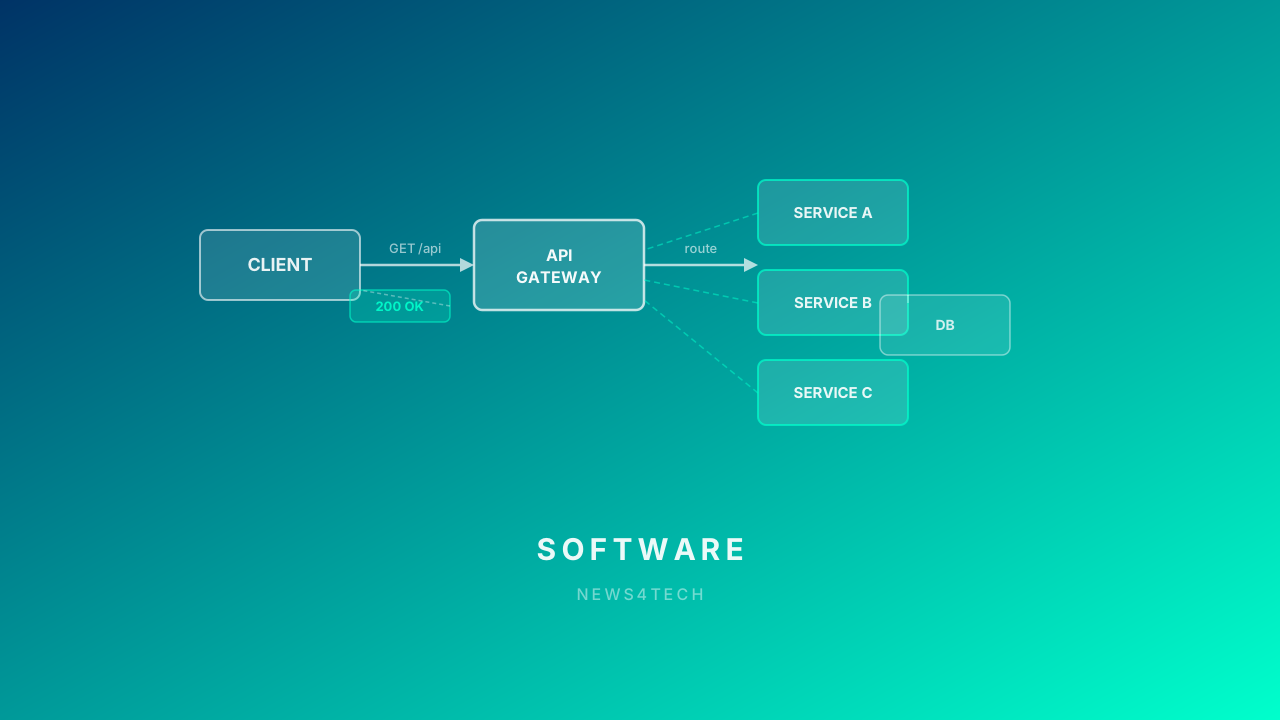
Beyond code generation, the “Agentic” era is taking over DevOps operations. Modern platforms are integrating AI to handle complex, real-time data issues that traditional scripts fail to resolve. Tools like Argo CD are moving beyond simple GitOps pipelines toward AI-driven deployments, where intelligent agents can monitor structured production data, detect anomalies, and automatically rollback or scale infrastructure without human intervention.
We are officially in the “find out” stage of AI, where the true cost of computation is passed to the user, demanding measurable ROI in engineering pipelines.
Why It Matters
This shift fundamentally changes the economics of software development. Usage-based billing for GitHub Copilot means that sloppy prompting or leaving autocomplete running aimlessly will now have a direct financial penalty. Engineering managers will need to track AI token usage just as strictly as they monitor cloud compute costs. It validates the idea that AI is not a magic wand, but a raw utility resource similar to electricity or bandwidth.
Furthermore, the rise of AI agents in DevOps indicates a shift in the skills required for system administrators and reliability engineers. If an AI agent within Argo CD can automatically parse deployment logs, identify a memory leak, and execute a rollback, the human role shifts from performing the task to orchestrating the agent.
However, as industry experts point out, these LLM issues are ultimately data issues. An AI deployment agent is only as good as the telemetry and structured data it receives. Organizations that fail to maintain clean observability data will find their AI agents hallucinating infrastructure changes, leading to catastrophic outages. The future belongs to teams that treat data quality as a first-class citizen in their automated pipelines.