2026 Hardware Bottlenecks and Breakthroughs
The artificial intelligence revolution is fundamentally constrained by physics and supply chains. While software models scale exponentially, the silicon required to train and run them must be physically manufactured. In 2026, the hardware sector is experiencing massive leaps in density and production capacity, contrasted sharply by notable retreats from legacy players struggling to keep pace.
Breaking Physical Silicon Limits
At the foundation of this physical scaling is ASML. The Dutch tech giant, which holds a functional monopoly on extreme ultraviolet (EUV) lithography machines, has announced plans to significantly increase production. These critical machines are the only way to print the microscopic transistors required for next-generation AI chips, making ASML the ultimate bottleneck for the entire global compute supply chain.
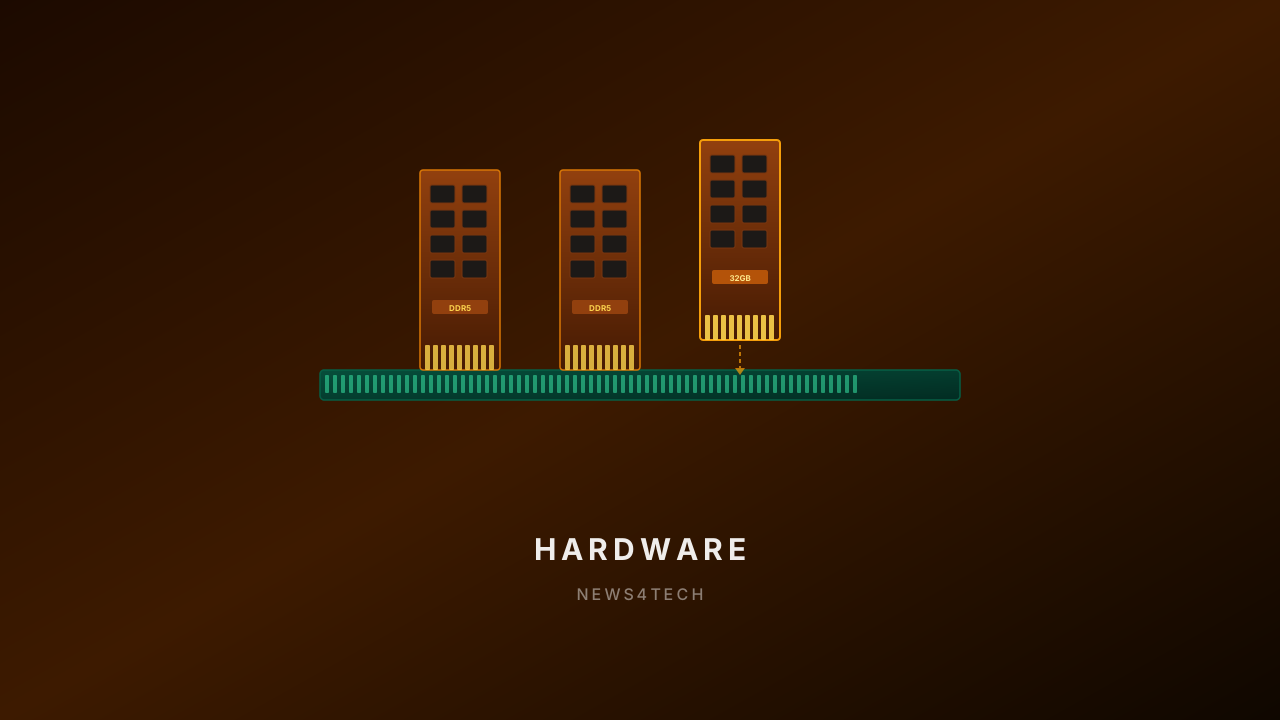
In the memory sector, Samsung has achieved a massive breakthrough. The company boosted DRAM cell density by a staggering 50% using its new sub-10nm (10a) technology. By implementing a Vertical Channel Transistor (VCT) process, Samsung places capacitors on top of transistors, drastically shrinking the footprint. As AI data centers drain available RAM globally causing DDR5 prices to soar this breakthrough is critical to sustaining large-scale LLM inference workloads.
However, not everyone is thriving in this hyper-competitive landscape. Intel has reportedly reshuffled its dedicated Arc desktop GPU roadmap, effectively skipping the Xe3 “Celestial” architecture for gaming. While Intel will continue to provide integrated graphics, the company is pivoting its top-tier silicon almost entirely toward professional and AI workloads, leaving PC gamers out in the cold.
The race for compute power has turned basic hardware fabrication into the most critical geopolitical and economic bottleneck of the decade.
Why It Matters
For system architects and IT buyers, these hardware shifts dictate future budgets and capabilities. Samsung’s density breakthrough will eventually alleviate the severe RAM shortages affecting servers, but high-performance DDR5 will remain at a premium in the short term. Meanwhile, Intel’s retreat from high-end dedicated gaming GPUs cements NVIDIA’s dominance, ensuring that consumer graphics cards will remain incredibly expensive as AI companies compete for the exact same silicon.