A New Era for AI Infrastructure
For years, the narrative in the artificial intelligence industry has been entirely dominated by GPUs. Nvidia’s record-breaking valuation was built on the premise that graphics processing units are the only hardware capable of handling massive AI workloads. However, a major shift is occurring right now. Meta has just signed a multi-billion dollar agreement to purchase tens of millions of AWS Graviton 5 CPU cores from Amazon. At the same time, the industry is battling a severe, escalating memory crisis affecting both RAM and NAND storage.
CPUs Reclaim The Spotlight
Meta’s decision to lean heavily into AWS Graviton CPUs highlights a fundamental change in how AI is being deployed. While GPUs remain essential for training massive language models, the rise of “Agentic AI” changes the inference landscape. AI agents require real-time reasoning, multi-step orchestration, and constant database querying. These workloads are highly sequential and demand high single-thread performance, tasks where advanced CPUs actually excel and offer far better cost-efficiency than power-hungry GPUs.
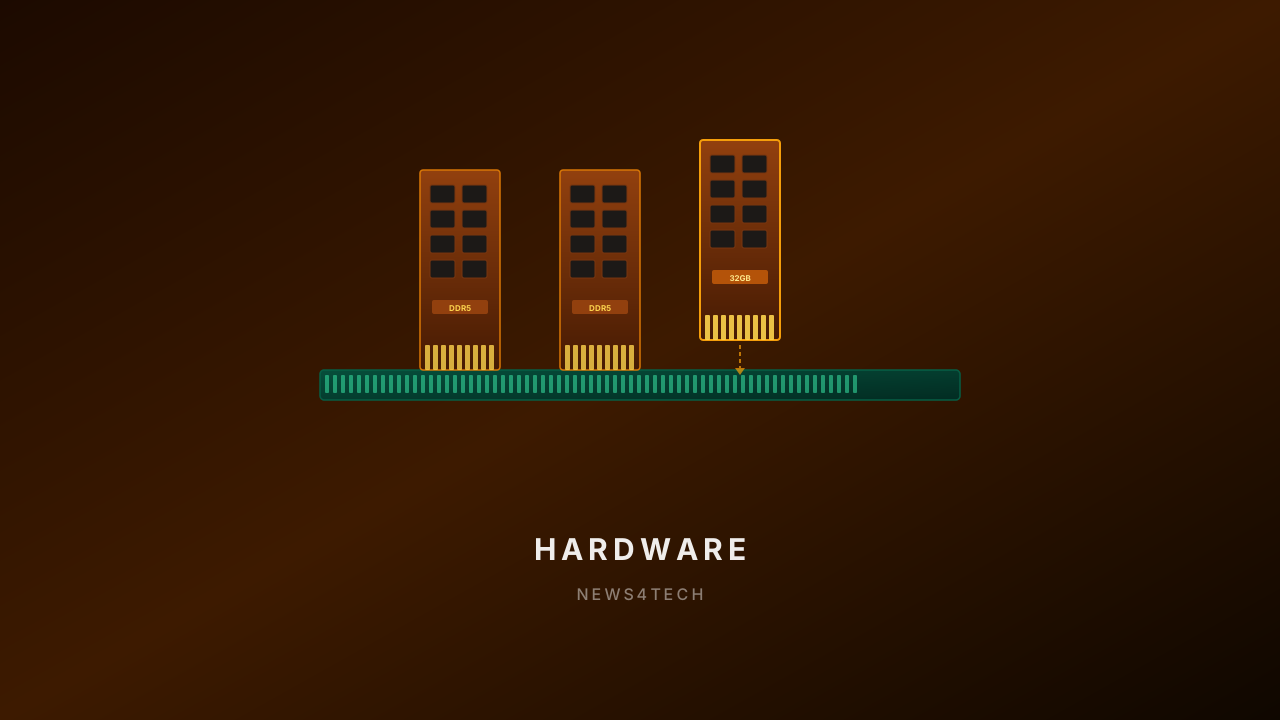
Simultaneously, the industry is facing a severe bottleneck: memory. The demand for high-speed RAM and storage required to run local AI models has stripped the supply chain bare. SK Hynix recently noted that software optimizations, like Google’s new TurboQuant algorithm, are ironically making the crisis worse. By allowing more AI context to fit into less memory, companies are simply deploying exponentially more agents, creating a vicious cycle of demand. The impact is already trickling down to consumers, with SSD prices surging and Apple’s new Mac minis being heavily marked up on secondary markets due to constrained RAM availability.
The AI hardware race is mutating. It is no longer just about raw computing power, but about memory bandwidth and the architectural flexibility to run autonomous agents at scale.
Why It Matters
This pivot has massive implications for cloud computing and enterprise hardware. Meta’s validation of ARM-based CPUs for AI inference shatters the idea that you must buy expensive GPUs to run AI agents. This opens the door for startups to build complex, multi-agent systems using much cheaper cloud infrastructure.
However, the memory crisis is the dark cloud hanging over this innovation. If the NAND and DRAM shortages continue, the cost of scaling AI operations will skyrocket. Developers building local-first AI applications will struggle as consumer devices become prohibitively expensive to upgrade. The tech world is learning a hard lesson: infinite AI reasoning capabilities mean nothing if you do not have the physical memory to hold the thoughts.